
The past few days have been... what shall I say? Eventful? I’ve had two painful events occur within a few days of each other; one involving a personal attack on my competence and the other involving painful loss and disappointment. One event that specifically deals with my fears and insecurities, and another that deals specifically with my deepest wants. It’s like a big, emotion-packed double-whammy.
But I was able to go hiking this weekend up to a summit 14,000 feet above sea level overlooking range after range of surrounding mountains. It turned out to be a very difficult hike; things didn’t always go the way they were planned, and we ended up hiking out in the dark with our headlamps lighting the path. Very challenging, but then again, very exhilarating when we finally made it back to the trailhead!
Anyway, I learned some lessons from the mountains while I was out there that tie in beautifully with the 16th verse of the Tao Te Ching. This verse talks about stepping back from the chaos of your world and observing how troubles and other circumstances come and go. But if you can step back and observe and recognize this cyclical pattern, you’ll see that this coming and going is part of nature and that each spin of the cycle does not mean the end of your world. In other words, the crazy whirlwind of life does not have to devastate you over and over again if you can manage to put it in perspective. You can be constant and impartial.
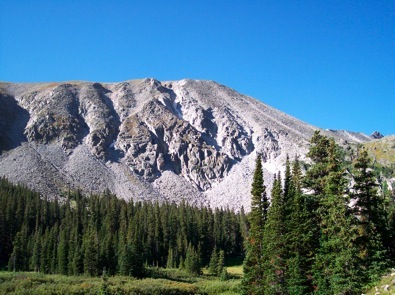
This lesson was reinforced for me by the mountain itself. First of all, there’s not much that is more constant than a mountain. Take a good look at the mountain, and then come back a hundred years later and you see pretty much the same mountain, unchanged other than by the seasonal decorations of nature. But I got intimate with one of the biggest mountains around this weekend, and I learned that a mountain is not so tough as it seems. I managed to change it.
That’s right. Little ol’ me. For better or for worse, I influenced a mighty mountain this weekend. In fact, I did it repeatedly, over and over, hundreds of times during the course of my trek up and back down the faces and ridges of that rocky behemoth. I would set my foot on a boulder the size of my washing machine, and it would shift - sometimes frighteningly so - beneath my weight. Once i took a break and sat down, leaning my back against a boulder, and it moved, sending two other boulders rolling down on either side of me!
Sure it scared me, but guess what? That mountain will never be the same. Those boulders will never roll uphill again.
In other words, a mountain is fragile after all.
Just like me. People’s words can hurt me. A friend can go away and I will feel like I’ve lost something. And I will never be quite the same.
But the mountain, though changed, is still there. it still rises gloriously out of the crust of the earth and defies our sense of proportion. The mountain, though fragile, is constant. How can it do this? That’s a very easy question to answer. The mountain is constant because it’s a mountain. Its nature is rock and force of weight and solid foundation. Although wind and trespasser can loosen its stones and send its little critters scurrying for cover, the mountain itself simply will not be moved from its center. It remains constant.
I can learn something from that. Things can happen in my life to bring me pain or disappointment. But as long as I remain in touch with that central part of myself and treat my fears and wants like loose boulders slipping across the outer slopes of my being, then I can detach myself from that slipping and sliding and remain constant. Wind and trespassers can wreak havoc on the pebbles all they want, but there is a mountain in this heart that is bigger than the pebbles... bigger even than the huge boulders that seem so significant but really are just loose scree sliding down my upturned slopes.
Another thing I learned from the mountain is that it is impartial. In one sense, it is harsh and unforgiving. One mistake on the part of a hiker while climbing that mountain, and that hiker’s life can be snuffed out like a squashed bug. The mountain is not being cruel; it simply remains true to itself without regard for external factors. It has no mind of its own, and therefore it does not yield to emotion or struggle with decisions.
So how can we learn from that? It’s not a perfect analogy, because we do have emotions and are required to make decisions. But I would say that we should draw from the mountain some of its impartiality. That’s kind of what we’re doing when we empty our mind. We are removing ourselves from all cares and all considerations and becoming impartial. And from that vantage point, many things become much clearer to our understanding.
For example, from that central place where my mind is empty of all care and emotion, I can look out and see that a colleague who is attacking my competence is struggling with her own fears and wants, and she really is not as evil as I at first believed. Do you see how powerful a tool this is? Do you see how liberating it can be? From this place you can watch the circumstances rise up like huge rogue waves around you, but you will know that these waves will eventually pass and you will be OK again. And that understanding gives you strength to not overreact and make things worse. In fact, you may find yourself smiling. Others will think you’re nuts. But you will see them as people who need your light. People who have good that you can tap into and influence for the better. You’ll have insight into their character that you otherwise would have been too preoccupied to see.
So look to the mountains. Draw from them their constant, impartial nobility. Face the wind and laugh at the trespassers. Give shelter to the life that huddles up to you, and give to the world that majestic beauty that rises up out of the crust of the earth. Let the pebbles and boulders of your fears and wants slip and slide all they want; just realize that they are not you. You are the peak itself.
You are the mountain.